
Check Saratoga Springs Voter Registration
The official Utah voter-information lookup is the starting point for a resident checking their own registration. Utah labels the service “Check My Status” and “Look Up My Status.” It returns current status and polling location. It is not a directory that lets a visitor browse the Saratoga Springs voter roll by surname. That distinction matters because the identity details used to find an individual record are not the same as fields released in a public data file.
| Lookup input | Control type | Required? | Verified detail |
|---|---|---|---|
| Identity fields | JavaScript application | Not documented | The accessible source does not expose exact labels, formats, or validation rules. Use the live form rather than guessing at field names. |
Open the live form, enter only the details it asks for, and review the status and polling response. If the application does not find the expected registration, do not treat that result as proof that no record exists. Contact Utah County Elections to check a name change, move, precinct assignment, inactive status, or other record issue. The county can also issue certified proof called a Voter Certificate.
The state lookup screen can be reviewed at the official voter-status source before entering personal information.
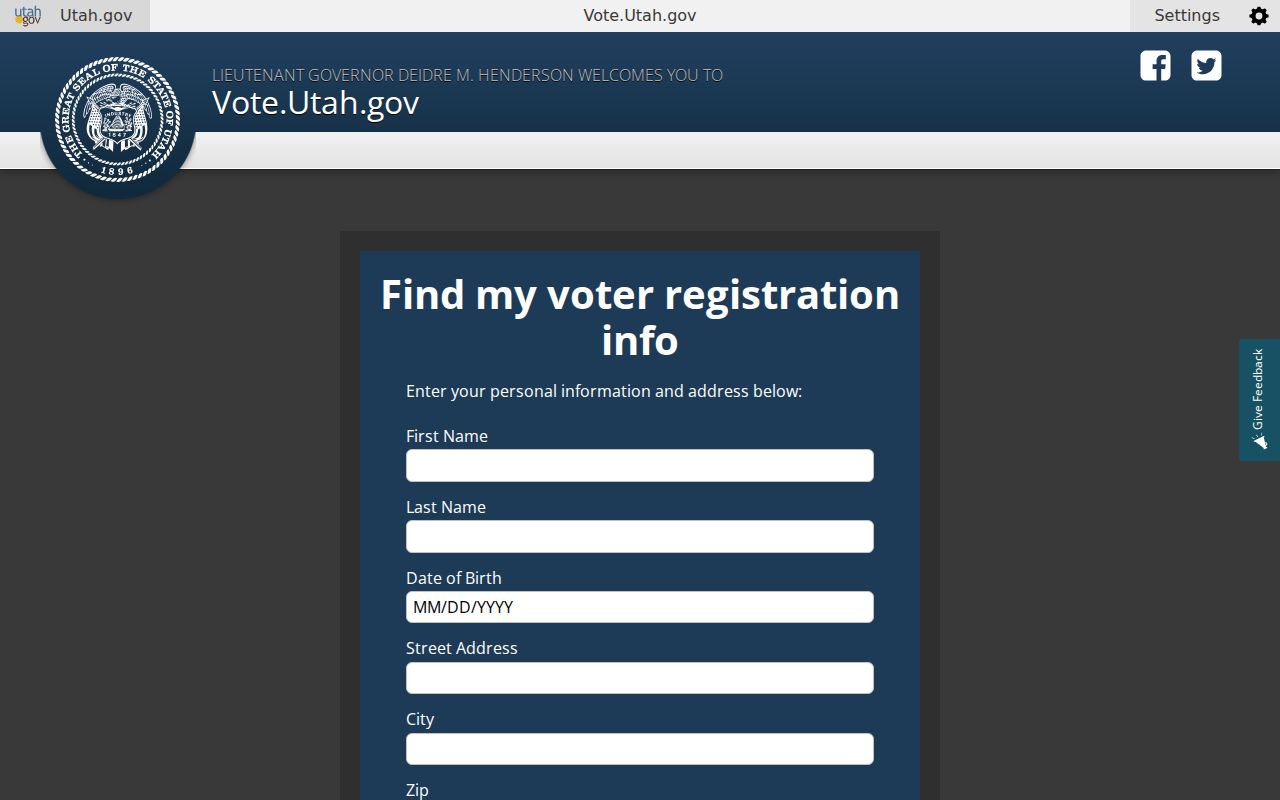
The captured form confirms that an individual status check belongs in the state service, while broad voter-list research follows a separate request route.
Fields in Utah Voter Records
Utah Code §20A-2-602 defines the data held in the public voter database. A Saratoga Springs entry can connect one registered voter to an address, precinct, party status, district assignments, record status, and a limited history of election participation. The voter identification number is part of the statewide database inventory. The state also records when the registration was last updated, which helps distinguish an old entry from a recent one.
| Identity | Full legal name, voter identification number, and a statutory age range rather than full birth date |
|---|---|
| Address | Complete residence address with unit details, county, and mailing address with city |
| Districts | Precinct; congressional; state House and Senate; state and local school boards; county council; city council |
| Affiliation | Political party or unaffiliated status |
| Record state | Active or inactive status and the last record-update date |
| Vote history | Elections in which the voter participated, never the choices marked on a ballot |
These fields can help confirm that two similar names belong to different people. Address, age range, precinct, and update date should be compared as a group. No single field should carry the whole match. A mailing address may also differ from the residence used to assign Saratoga Springs districts.
Saratoga Springs Vote History Facts
Participation history answers a narrow civic question: whether the voter took part in a named election. It does not reveal candidates selected, issues supported, or any other ballot choice. A “Who Has Voted” report can include voting method and the date a ballot was processed, but those facts still do not disclose how the ballot was marked.
Does a voter record expose a secret ballot? No. Utah’s published field description limits vote history to election participation. Treating a participation row as evidence of a person’s political choices would go beyond what the record says.
This limit is useful when tracing a relative’s civic activity or studying turnout patterns. It also sets a firm boundary. Voter rolls document registration administration, not personal voting decisions.
Note: Party affiliation is a registration field, but it does not prove how a Saratoga Springs resident voted in any election.
Protected Utah Voter Registration Data
Utah separates ordinary public voter fields from protected identity and contact data. Name, physical and mailing addresses, age range, party status, and participation history are generally in the public-field group. Full date of birth, driver-license or state-identification number, Social Security number, email address, and phone number remain protected under the state voter-record scheme.
Confidential by Utah law. Utah Code §§20A-2-601 and 20A-2-602 protect full birth dates, government identification numbers, Social Security numbers, email addresses, and phone numbers. At-Risk identifying information is also withheld under §20A-2-606.
Beginning in January 2027, a voter may consent to share email or phone information with the party with which that voter is affiliated. Consent is not the same as broad public release. For the larger public-records framework, Utah’s GRAMA process is addressed in the Saratoga Springs public records access resource, but GRAMA does not erase the specific protections placed on voter data.
Saratoga Springs At-Risk Voter Records
Utah’s At-Risk classification protects identifying voter information for people who face certain safety risks. Eligible categories include a victim or potential victim of domestic or dating violence, a law-enforcement member, a person covered by a protection or protective order, an armed-forces member, a public figure, or a person who lives with someone in one of those groups. The classification withholds identifying registration data from the public, parties, and candidates while allowing authorized government uses and stated anonymous statistics.
The Utah At-Risk Designation Request Form asks for a full name, a phone number or email, and either an address or date of birth to locate the registration. The applicant selects an eligible category. Depending on the category, an explanation may be required. A signature, date, and declaration under penalty of perjury complete the form.
Submit the signed request to the Utah County clerk or the Lieutenant Governor by mail, email, or drop-off. The state destination is Utah State Capitol Suite 220, PO Box 142325, Salt Lake City, UT 84114, and elections@utah.gov. Classification changes the voter record only. It does not remove the same facts from other government files or private databases.
Utah County Voter Registration Help
Utah County Elections is the local records office for Saratoga Springs voters. It handles county election administration, local voter questions, certificates, and requests for a city, precinct, county, or district subset. The Lieutenant Governor offers statewide data only, so a request narrowed to Saratoga Springs should go to the county rather than the state purchase channel.
Utah County Elections
100 E Center St, Suite 3100
Provo, UT 84606
801-851-VOTE (8683)
elections@utahcounty.gov
Monday through Friday, 8 a.m. to 5 p.m.
The Utah County elections service page provides the official local route for voter help and election records.
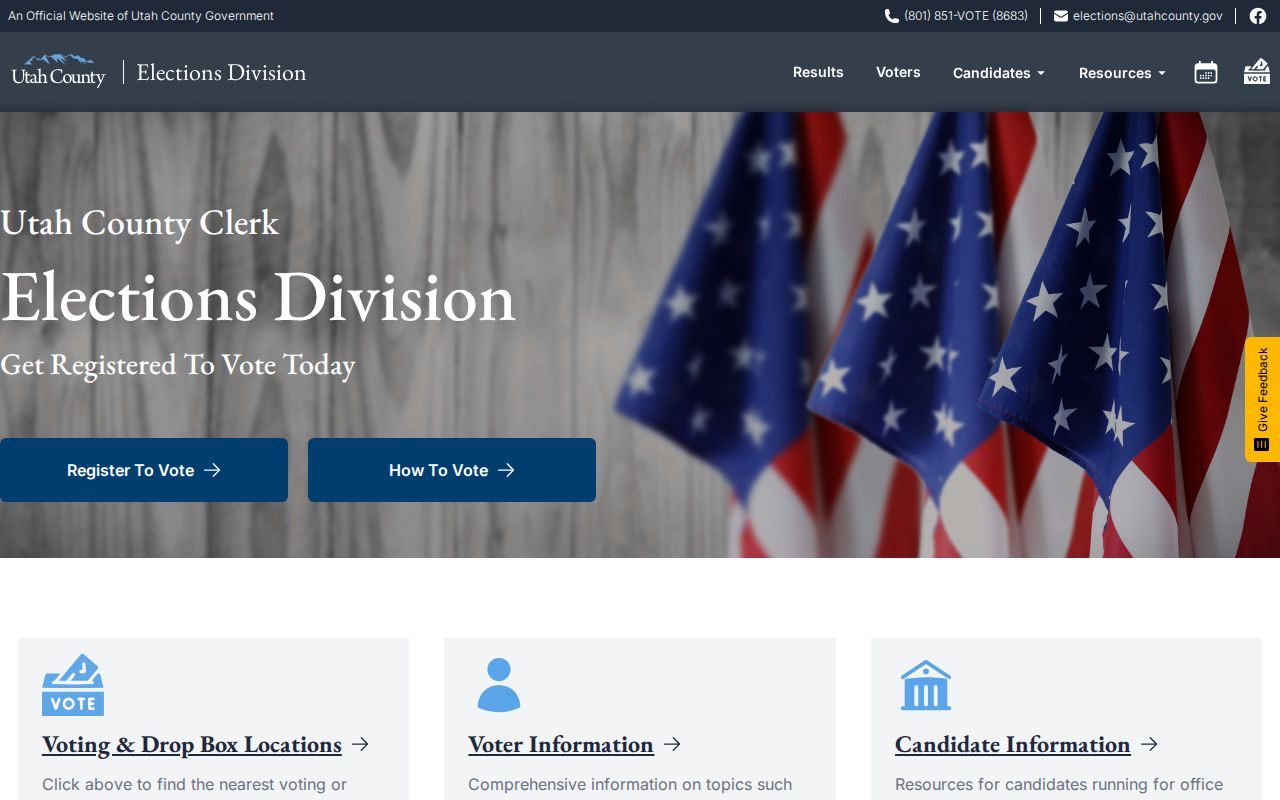
The county channel matters when a statewide product is too broad or when a resident needs direct help with a Saratoga Springs record.
Note: Provo is the Utah County seat, so local voter-file service is county based even though the voter lives in Saratoga Springs.
Buy Utah Voter Registration Files
The Lieutenant Governor sells the statewide voter database as a one-time purchase for $1,050. The tab-delimited file is about 150 MB, and a download link is emailed within one business day. The purchase has no refund, subscription, or free update. A later copy is a new request, so the date of the dataset should be preserved with any analysis or family-history notes drawn from it.
- Review the official Utah voter-data products and choose the statewide database only when statewide scope is needed.
- Use the linked state request route. The exact payment and requester field labels were not verified because the linked request form did not load during research.
- Pay the published $1,050 price and watch the supplied email address for the tab-delimited download link, which the state says arrives within one business day.
- Keep the file date with the data. Request a smaller Saratoga Springs, precinct, district, or county subset from Utah County instead.
The official Utah voter-data product page shows the distinctions among the database and election reports.
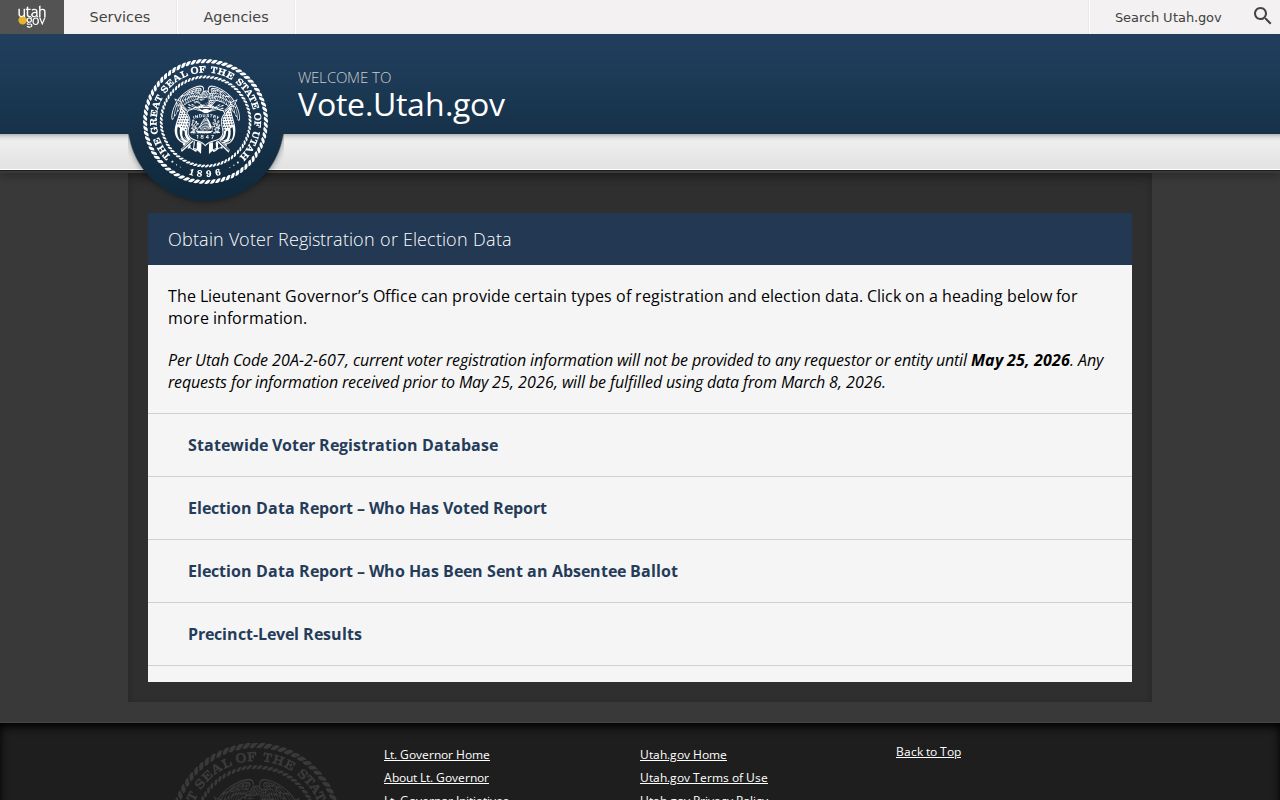
The screen reinforces that the full file is a paid data product, not the same tool used by a voter to check personal status.
Saratoga Springs Election Data Reports
Utah also sells two narrower reports for $35 per election. “Who Has Voted” and “Who Has Been Sent an Absentee Ballot” apply to regular even-year primary and general elections. They are not available for odd-year municipal elections or after an election. During the stated window, the reports are tab-delimited and emailed each day from 21 days before Election Day through the day before it.
| Election report | Published fields | Privacy treatment |
|---|---|---|
| Who Has Voted | Voter ID, legal name, residence and unit, county, precinct and congressional district, voting method, processed date, party status | At-Risk entries appear without identity |
| Absentee Ballot Sent | Voter ID, name, address, county, precinct and congressional district, ballot-order and processed dates, party status | Private records are excluded or anonymized |
Recent precinct-level results can be requested without charge. Those results measure the count in a geographic unit; they do not connect any named person with a ballot choice.
Saratoga Springs Voter Roll Maintenance
An inactive voter record is not the same as a final finding that the person no longer lives in Saratoga Springs. Utah defines inactive status through two regular general elections without voting plus failure to respond to a county notice. The state’s National Voter Registration Act dashboard also tracks confirmation cards tied to returned mail, inactivity, or an apparent move, as well as updates and removals for causes such as death, inactive status, or a voter’s request.
The Utah NVRA dashboard publishes removal details from November 2025 forward and retains reports for two years. Statewide statistics on July 20, 2026 counted 1,778,184 active voters and 310,424 inactive voters, with downloadable history from 2014 through 2026. These statewide numbers do not explain why a named Saratoga Springs voter changed status.
A temporary rule under Utah Code §20A-2-607 froze current-data delivery until May 25, 2026 and required older requests to use a March 8 snapshot. That freeze has ended, but it shows why a “current” voter file always needs a dataset date. Ask Utah County about an individual status instead of inferring a cause from statewide maintenance data.
Use voter data lawfully. Do not use a voter record to stalk, monitor, threaten, harass, or harm anyone. Utah Code §76-5-106.5 covers repeated conduct, including surveillance, unwanted contact, and obtaining or spreading information through online means, with penalties that can rise from a class A misdemeanor to a felony.
Historical Saratoga Springs Voter Records
Saratoga Springs incorporated in 1997, so older election research does not follow a long city archive. It shifts to Utah County and statewide collections. Utah County Clerk Election Registers in State Archives Series 5018 consist of official registered-voter booklets by election district, but their four-year retention means they should not be treated as a complete historic run for Saratoga Springs.
Permanent statewide voter registration appears in State Archives Series 28818. Territorial Commission minutes in Series 1126 cover 1882 through 1896 and document federal registration and election administration, including disputes. The three-reel collection spans 3.5 cubic feet. Search the Utah State Archives catalog or ask reference staff to check the geographic and name coverage before assuming that a territorial entry concerns land now inside Saratoga Springs.
Historical access is therefore a file-and-catalog process, not a present-day status lookup. Begin with an Archives series description, note the election district and date, then seek the surviving register or minutes. Modern voter registration questions belong with the state lookup or Utah County Elections.
Note: Retention varies by series, so a missing poll book does not prove that a Saratoga Springs voter was never registered.