
How Saratoga Springs Records Divide
Saratoga Springs does not have one public records warehouse. The city Recorder keeps ordinances, resolutions, contracts, council proceedings, city elections, business licensing, annexation notices, and historical municipal documents. Utah County controls land instruments, ownership, tax records, GIS, marriage licensing, and county elections. Utah courts hold case files, while state agencies issue vital certificates and publish license, business, and corrections lookups.
| Records | Responsible custodian | Web discovery | Access route |
|---|---|---|---|
| City actions and licenses | Saratoga Springs City Recorder | Posted agendas, notices, code, Document Center | Free posted files or city GRAMA request |
| Deeds, liens, plats, ownership | Utah County Recorder | Land Records, abstracts from 1985 forward | Free index; office help for older material and copies |
| Property value, tax, GIS | Assessor, Treasurer, GIS | Land Records and Parcel Map | Free web tools or the responsible county office |
| Local and district cases | Justice Court or Fourth District Court | Utah Courts Xchange | Paid web search, free terminal, or clerk request |
| Birth, death, marriage, divorce | Utah Vital Records, county clerk, or court | Ordering pages and historic Archives indexes | Eligibility-based order or public archive access |
| Jail and state custody | Utah County Sheriff or Utah Corrections | Agency inmate and offender searches | Free locator or agency records request |
Open status depends on the record, not merely on whether a name appears online. Sealed and expunged cases, juvenile matters, adoption files, protected family-case details, recent vital certificates, motor-vehicle personal data, and enumerated private GRAMA records have separate limits. A public index may prove that a file exists without opening every page in that file.
Saratoga Springs GRAMA Access Rules
Utah's Government Records Access and Management Act, called GRAMA, permits inspection of public material during normal office hours without an inspection charge. The law does not state a Utah-residency requirement. A written request must go to the government entity that retains the file, so a city request cannot compel Utah County or a court to produce a record held elsewhere.
The request must give a name, mailing address, daytime phone, accepted email when available, and a reasonably specific description. Useful details include the record type, subject names and variants, date span, address or parcel, department, and any case, citation, entry, license, or certificate number. Ask for inspection, an electronic copy, a plain copy, or a certified copy. Those are different products and may have different costs.
- Custodian
- The office that retains and answers for the record.
- Index
- A discovery list showing that a filing exists, often with names, dates, and identifiers.
- Certified copy
- An office-issued copy formally authenticated by its custodian.
- Exemption
- A legal basis for withholding all or part of a record.
Saratoga Springs Records Response Clocks
A Utah entity must answer as soon as reasonably possible and generally within ten business days. A supported expedited request that primarily benefits the public has a five-business-day track. The agency may provide the record, approve access, deny access with legal authority, identify another likely holder, or cite an extraordinary circumstance with an estimated response time. No timely answer is treated as a denial.
Fees may cover reasonable actual cost. Inspection is free, and the first 15 minutes of employee search and retrieval time generally cannot be charged, subject to statutory exceptions. A fee waiver may be available when release chiefly benefits the public, the requester is the record's subject, or the record directly affects the requester's legal rights. A denial must explain appeal rights under GRAMA.
The Utah Open Records Portal helps route requests, locate records officers, and reach the Government Records Ombudsman. It is a request gateway, not a single database holding every Saratoga Springs file.
The official Utah portal shown below is the state route for GRAMA support and request routing.
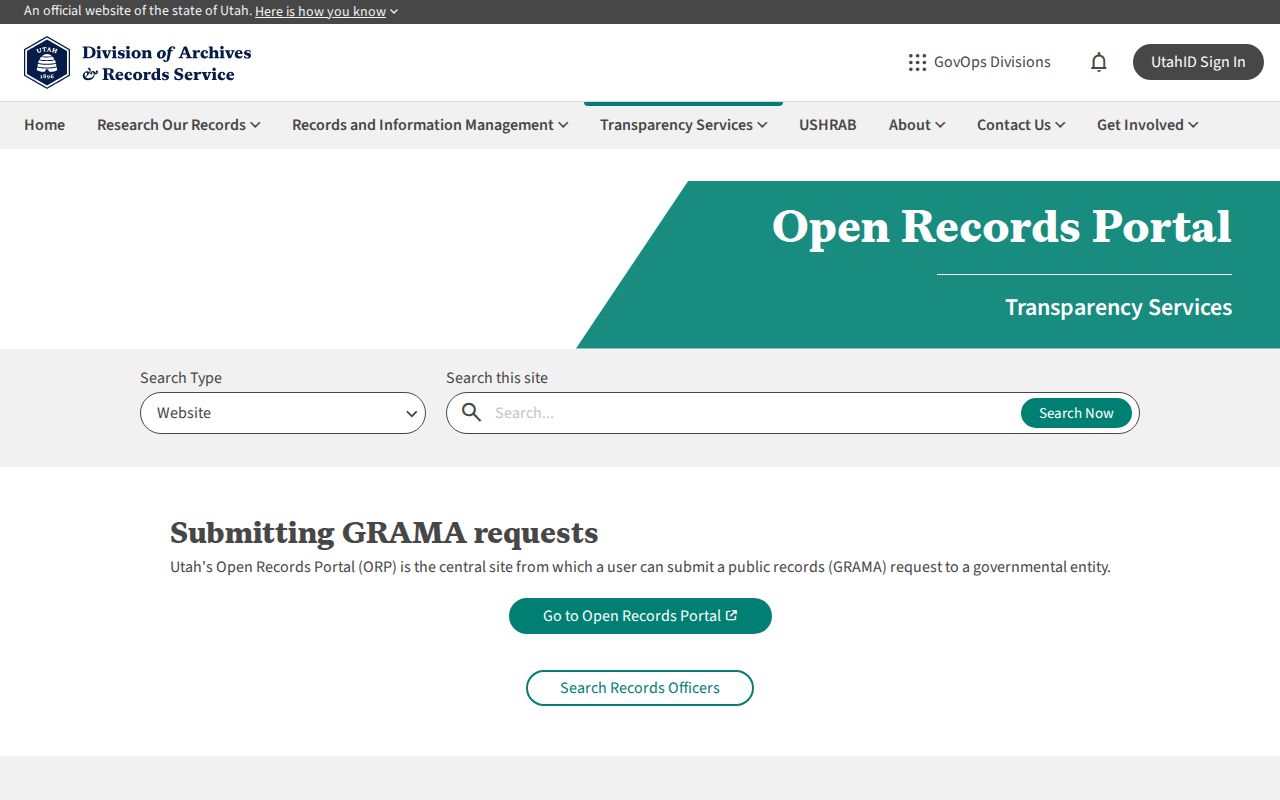
Its records-officer tools help identify the right entity before the response clock begins.
Note: Keep the sent request, delivery proof, response, cited classification, and appeal notice together in case an administrative appeal becomes necessary.
Saratoga Springs Land Record Coverage
The Utah County Land Records portal combines owner, address, serial, document, tax, and map discovery. Property abstracts are fully searchable from 1985 forward. Earlier deeds did not vanish, but older work may require Recorder staff, abstract books, plat images, REDI image groups, or an in-person request. County deeds reach back far beyond the city's December 1997 incorporation.
That date and geography matter. Saratoga Springs runs more than eleven miles along northwest Utah Lake and has annexed large areas. An older person or parcel trail may sit under unincorporated Utah County, an earlier nearby community, a subdivision, or a legal description instead of the present city name. The county index, not a city-only search, is the durable starting point for such land records.
A web abstract is discovery metadata. It can show the title chain and point to an entry or book and page, but a certified instrument must come from the Recorder. For a pre-1985 chain, provide the known owner, parcel serial, subdivision or legal description, and approximate date to staff rather than assuming no online hit means no deed exists.
Search Saratoga Springs Recorder Fields
The owner-name form accepts a surname alone or the pattern “Last, First Middle.” Its scope control is unusually useful because “All Records” includes more than the current assessment roll, while “Never Valid Only” can reveal retired parcels. Address search separates the street number, direction, name, type, and city or location. Kind-of-Instrument search accepts a code such as WD for Warranty Deed and an optional starting recording date.
| Search input | Control | What to enter | Practical use |
|---|---|---|---|
| Owner name | Text | Last name or Last, First Middle | Find current and former ownership ties |
| Record scope | Radio choice | All, Current Only, or Never Valid Only | Separate active parcels from retired ones |
| Address | Structured fields | Number, direction, street, type, location | Resolve a site to a parcel serial |
| Instrument kind | Code or selector | Document type and optional start date | Limit results to deeds, liens, or another filing class |
A nine-digit Utah County serial encodes book in the first two digits, page in the next three, and parcel in the last four. An “ET AL” display means more owners exist, so ask the Recorder for the full owner set. Parcels without street addresses can still be reached through serial, subdivision, legal description, PLSS land coordinates, or the parcel map.
Saratoga Springs Property Record Roles
Three county offices share the property ecosystem but answer different questions. The Recorder controls recorded instruments, ownership names, and legal descriptions. The Assessor controls market value, appraisal data, and exemptions. The Treasurer handles tax collection, delinquency, payoff, and tax-notice mailing-address changes. A tax owner is not proof of who occupies the property, and a GIS boundary is not a survey.
The Utah County Parcel Map accepts an address, parcel serial, book and page, owner, city, or PLSS location. It also exposes current layers and historic parcel geometry. Historic dates show when geometry entered the online property system, not the legal recording date. Use deed dates for the legal chain.
Utah County Property Watch sends free alerts after a deed or lien is processed. It does not block, validate, or prevent a filing. Treat an alert as a cue to check the official abstract or image and contact the Recorder, not as title protection.
Saratoga Springs Court Record Access
Saratoga Springs Justice Court handles limited local traffic, infraction, misdemeanor, ordinance, and small-claims matters. It is not a court of record, a phrase about appellate structure rather than the absence of files. Felony, probate, divorce, and broader civil cases belong to Utah's Fourth District Court. Public statewide discovery runs through Utah Courts Xchange.
Xchange searches by jurisdiction, case number, party or company, wildcarded first name, case type, statewide or local scope, birth date, citation, and filing, disposition, or judgment dates. Results may show case identifiers, parties and roles, charges, pleas, dispositions, hearings, balances, and available documents. Probate indexing can identify decedent and heir roles. A docket row is not the full pleading.
Web searches and documents carry charges, though published pages show a discrepancy between two quoted per-search amounts. Public Xchange terminals at most district courthouses and the Utah State Law Library avoid the online search fee. The local Justice Court clerk supplies its own file and GRAMA form; Fourth District supplies district and probate files. State Archives may hold judicial records more than 50 years old. Federal matters use PACER or the federal clerk.
Case privacy. Adoption, juvenile, sealed, expunged, mental-health, and designated family or protective details are excluded or restricted. A public case hit does not open every document.
Three Saratoga Springs Records Channels
General city files, police reports, and Justice Court files take different paths. Send ordinances, contracts, minutes, licensing, permits, annexation, and other municipal material to the City Recorder after checking posted pages and the Document Center. CityWorks handles permit applications and tracking behind an account, but no anonymous permit-history name index was verified. A narrow address, parcel, date, and permit-type request is the fallback.
Police records use the city's NextRequest portal, not the general Recorder form. The city asks for photo identification, incident date, a detailed record list or reason, and the case number when known. Published police fees include $13 for case photos, $13 for a loss or traffic-accident report, and $8 for a clearance letter. Pending case discovery may route through the prosecutor or counsel.
Justice Court uses its own downloadable form or clerk channel. The form asks for a specific description, case number if known, inspection or copy choice, a requester-set cost ceiling, contact details, signature, and any basis for access to a nonpublic record. Asking for electronic delivery can reduce reproduction costs.
Note: A single request sent to all three channels can delay the search because each office is responsible only for the records it retains.
Saratoga Springs Vital Record Timelines
Utah birth certificates become public after 100 years, death certificates after 50 years, and marriage or divorce records after 75 years. Recent copies require identity and proof of an eligible relationship under Utah law. GRAMA does not override those vital-record limits. Utah's Office of Vital Records and Statistics covers births and deaths from 1905 forward, plus marriage and divorce abstracts for 1978 through 2010.
Outside the abstract span, request marriage material from the Utah County Clerk and divorce records from Fourth District Court. The court file is richer than a divorce abstract. Historic Utah County birth and death registers bridge 1898 through 1905, while older open records move to Utah State Archives catalogs and images.
Utah Vital Records explains certificate access and ordering on the source shown here.
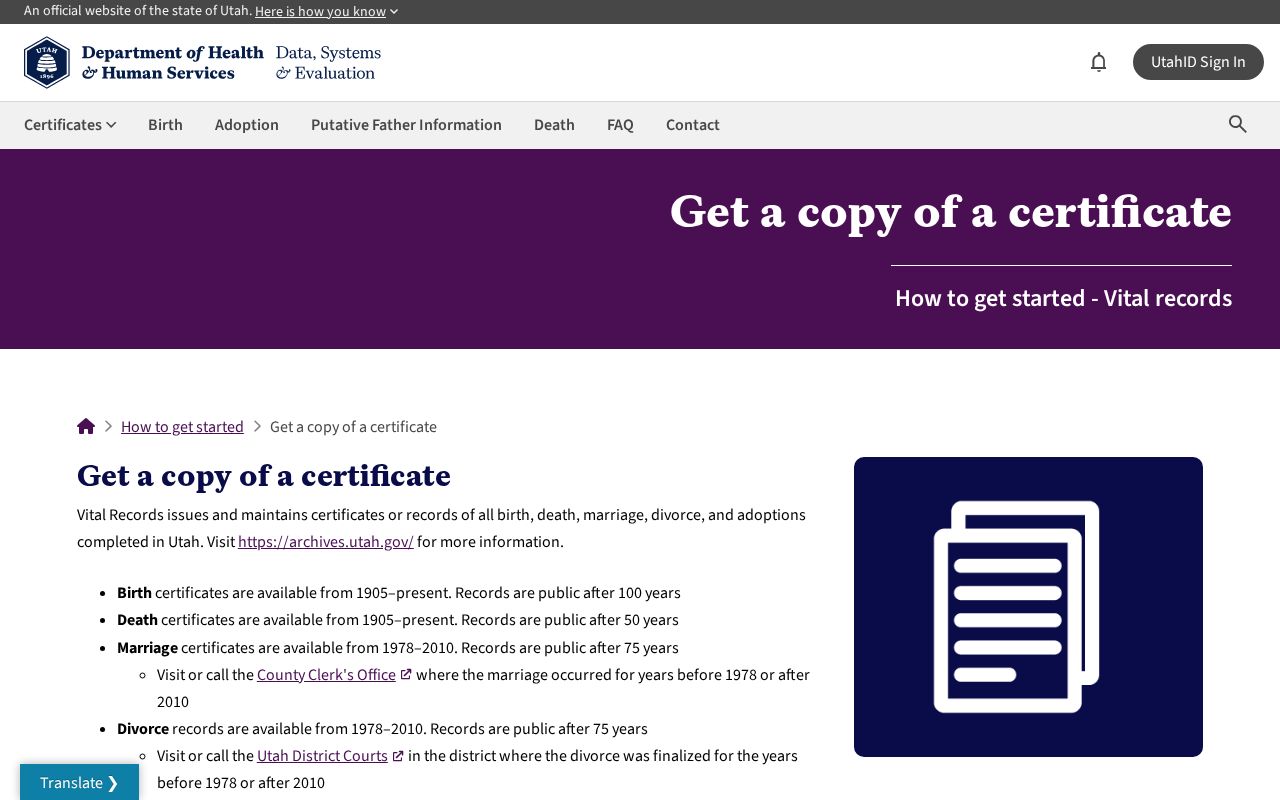
The ordering page helps distinguish a restricted certified certificate from an older public archive record.
Current first-copy fees are $25 for birth, marriage, and divorce certificates and $35 for a death certificate. The fee is retained as a search fee even when no record is found. Order online, by mail with the signed form and ID, or through the local health department in person. A dated 2026 notice reported about a six-week online and mail backlog. Since November 2025, an adult Utah-born adoptee may request a non-certified original birth certificate through the adoption registry.
Saratoga Springs Custody Record Lookups
The Utah County Sheriff inmate search focuses on county bookings and warns that a new booking may take 24 hours to appear. Search by name, arrest date, or current-inmate status. Results can include booking identifiers, agency, charges, court, custody status, release data, and a recent photo. The code SSJC identifies Saratoga Springs Justice Court.
The Utah Department of Corrections offender search covers people now incarcerated, on probation, or on parole in the state system. It accepts an offender number or first and last name and may show status, location, offense, sentence, and parole data. Utah VINE provides anonymous custody-status checks and release, transfer, escape, or death alerts, but it should never serve as the sole safety plan.
These systems cover different populations. A no-hit in the jail tool does not rule out state supervision, and a DOC no-hit does not rule out a local booking. Agency GRAMA requests remain available for responsive public material not published in a locator.
Privacy Limits on Saratoga Springs Records
GRAMA classifies some government material as private, controlled, protected, or otherwise restricted. Section 63G-2-302 lists private categories, while Section 63G-2-202 governs access by a record subject, guardian, authorized representative, or a person holding a qualifying recent notarized release. A public office may redact protected fields while releasing the rest of a responsive record.
The Utah Consumer Privacy Act gives qualifying rights against covered private businesses, including access, deletion of data the consumer supplied, data portability, and an opt-out from sale or targeted advertising. It does not erase government records. Likewise, Utah's Address Confidentiality Program and at-risk voter classification protect defined address or voter information through their own processes rather than deleting unrelated court, deed, or licensing files.
Federal motor-vehicle law also limits personal data in driver and vehicle files. When a portal withholds an address, birth date, contact field, or case document, check the governing classification before treating the missing data as a technical error.
Saratoga Springs Public Records Offices
The correct office is usually determined by who created the record. City Hall is the municipal starting point, while most property work goes to the county seat in Provo. Court access splits again between the local limited-jurisdiction court and Fourth District. Confirm hours before a trip when a same-day inspection or terminal search matters.
Saratoga Springs City Recorder
319 S. Saratoga Road
Saratoga Springs, UT 84045
801-766-9793 ext. 192
Utah County Recorder
100 E Center St, Suite 1300
Provo, UT 84606
801-851-8179
Saratoga Springs Justice Court
367 S. Saratoga Road
Saratoga Springs, UT 84045
801-766-6508
The Utah County Recorder is open Monday through Friday, 8:30 a.m. to 5 p.m. The city Justice Court lists weekday hours from 8 a.m. to 4 p.m. City Recorder staff also handle elections, business licensing, public notices, and cemetery burial-right coordination, so a clear subject line helps route a municipal request.
Request Saratoga Springs Public Records
Start with the known custodian and its direct index. A well-scoped request saves staff time and makes a fee estimate easier to judge. Separate the index or metadata needed for discovery from certified images needed for official use. If an office does not retain the file, ask it to identify the likely holder as GRAMA provides.
- Identify the keeper. Decide whether the city, Utah County, a court, or a state agency created and retains the material.
- Check direct access. Search posted files, Land Records, Xchange, Archives, or the agency locator before filing a formal request.
- Describe the record. Give names and variants, a narrow date range, record type, address or parcel, and known case or filing numbers.
- Choose the product. State whether inspection, an electronic file, a plain copy, or a certified copy is needed, and set a cost ceiling.
- Track the answer. Save proof of delivery and the response date. Narrow an overbroad request or use the stated appeal route after a denial or missed deadline.
Voter-file access follows its own statutes and products. The statewide file comes from the Lieutenant Governor, while a Saratoga Springs or precinct subset goes through Utah County. The dedicated Saratoga Springs voter records resource explains that public and protected split without treating voter data as an ordinary GRAMA file.
Use records lawfully. Open records support family history, estate research, civic review, and fraud checks. Utah law prohibits stalking and harmful misuse of personal information.